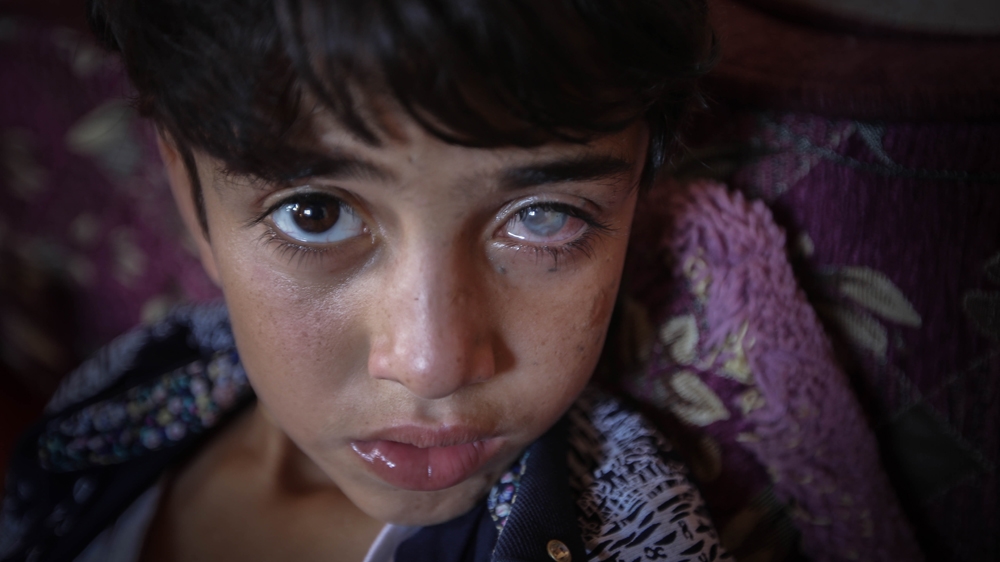
The prevalence of psychological trauma among refugee youth should be an issue of utmost urgency for us all.
Belen
Fernandezby Belen Fernandez: In early January, as the world waited to
see whether the United States's addiction to carnage and destruction
would lead to all-out war with Iran, US congresswoman Ilhan Omar
remarked: "[E]very time I hear conversations around war, I find myself
being stricken with PTSD [post-traumatic stress disorder]."
At
the age of eight, Omar fled war-torn Somalia for Kenya, where she spent
four years in a refugee camp. Her PTSD comment generated mockery and
rage from the usual suspects in the US political establishment and
commentariat; apparently, US soldiers deserve a monopoly on this
particular disorder and refugees need not apply.
But in
an age of unprecedented levels of forced human displacement - in which,
according to the UN Refugee Agency, over half of the world's refugees
are children - the prevalence of psychological trauma among refugee
youth should be an issue of utmost urgency for anyone concerned with,
you know, the future.
Trauma incubators
The video that shows ‘caged’ children on the US border
Take, for example, the severely overcrowded Moria refugee camp on the Greek island of Lesbos, currently home to some 7,000 migrant children. In 2018, reports emerged of children as young as 10 attempting suicide; more recently, a psychologist in the camp warned that preschool-aged kids were banging their heads against walls and pulling out their hair, among other behaviours, while children as young as seven said they wanted to die.
Such camps serve as incubators for trauma - which for many children is cumulative and multifaceted, encompassing traumatising experiences in the home country, traumatising experiences during migration, and the trauma of being trapped in unsanitary and unsafe camps that offer no space for psychological recovery or hope. Obviously, having parents who are themselves traumatised can also have serious repercussions on a child's mental health.
Caoimhe Butterly - an Irish trainee psychotherapist and director of the award-winning documentary The Border, who has spent six years visiting refugee camps in Greece, Calais and the Balkans - told me that children in the camps are increasingly "expressing distress, despair and hyper-vigilance or self-harm" as well as "withdrawal and shut-down".
Children are the "casualties of policies of containment and the cruelty of indefinite limbo", she said, and the "cognitive, emotional and physiological impacts of a system that is in itself re-traumatising are resulting in a profound crisis". Psychological debt
Gaza: Children suffer from war trauma three years on | Middle East .. The crisis is similarly on display in the Pacific island nation of Nauru, notorious for its service on behalf of Australia as an offshore migrant detention centre. A New York Times excursion to Nauru produced such soundbites as this one from eight-year-old Sri Lankan refugee Sajeenthana, who had been a de facto prisoner of the island since the age of three: "One day I will kill myself … Wait and see, when I find the knife. I don't care about my body."
And while the US had pledged to lend an unusual hand by taking in some of the Nauru refugees, a subsequent wave of US rejections of refugee resettlement applications had reportedly "contributed to a rapid deterioration of people's mental states", the Times noted.
To be sure, the US is in great psychological debt to the rest of the world - particularly on account of its habit of waging devastating wars that traumatise people and drive them from their homes.
In addition to US-waged slaughter-fests like Afghanistan and Iraq, the empire has also enabled all manner of other bloodshed, including the Saudi-led conflict in Yemen. In August 2018, a US-supplied bomb killed 40 children on a school bus in Saada.
As for other obstacles to the physical and psychological wellbeing of Yemeni youth, even UNICEF does not mince words with its assessment that Yemen has "become a living hell for the country's children", who are "being robbed of their futures". 'Designed to traumatise' THE CRIMINALITY AND SAVAGERY OF THE CANADIAN GOVERNMENT
The US border, too, is a prime trauma spot. Recent years have seen migrant children forcibly separated from their parents, kept in cages, and sexually abused in US custody. Visitors to the "border prison camps" have observed that some of the children are "too traumatised to even interact".
Now, with Donald Trump's decision to force many asylum seekers to wait indefinitely on the Mexican side of the border - in positions of extreme vulnerability - as their asylum claims are processed, there is talk of another burgeoning mental health crisis.
Ariana Sawyer of Human Rights Watch (HRW) speculates that children will be especially affected, and argues that the so-called "Remain in Mexico" policy was in fact "designed to traumatise asylum-seekers further, to the point where they become willing to give up on their asylum claims".
As if we needed any further evidence that the US government is itself acutely psychologically unwell.
Elsewhere around the globe - from children hanging themselves in camps for displaced people in South Sudan to the prevalence of PTSD among Syrian refugee youth - the future is also looking pretty bleak.
When in 2015 I visited Syrian refugee camps in Lebanon's Bekaa Valley, an elderly camp resident surmised that the reason so many young refugees were departing for Europe on "boats of death" was that they saw themselves as dead already. Thus, he reasoned, the risks of the voyage were immaterial.
Hopeless future?
Then, of course, there is Palestine, which has long been synonymous with the phenomena of forced displacement, refugees and trauma. In the Gaza Strip, where the majority of the population are refugees from what is now Israel, many children exhibit signs of intense psychological suffering - a natural reaction, no doubt, to Israel's conversion of the territory into an open-air prison and site of habitual Israeli military massacres as well as other forms of torment.
Regarding the issue of Gazan mental health, former Oxfam spokesman Karl Schembri aptly posed the question: "How can you talk about post-traumatic stress interventions in Gaza when people are still in a constant state of trauma?"
A recently published study of refugees in Denmark meanwhile finds that children of parents with PTSD are "vulnerable to intergenerational transmission of psychopathology" and that even children born in Denmark had a "non-negligible increased risk".
Now, with mass forced displacement the name of the game - and a global elite committed to war, punitive economic policies, and a general destruction of the planet - it seems the world itself may be headed for a constant state of trauma.
CATHOLIC AND TORONTO...CHILDREN'S AID... will came to make you to pay
Go to YOUTUBE to see and hear the hiding video
https://www.bitchute.com/video/Z5IVye9moR0/
CAUGHT ON HIDDEN CAMERA: Ezra Levant of Rebel News INTERROGATED For His Book Exposing Justin Trudeau
Government agents or as I call them thugs of the state interrogated
author and journalist Ezra Levant because he dared to write a book about
Justin Trudeau during a federal election. The two former RCMP officers
(who used to specialize in terrorism cases) grilled Levant for over an
hour all while being secretly filmed by Levant unbeknownst to them! In
this video Dan Dicks of Press For Truth goes over some of the highlights
of this counter interrogation by Levant where he puts these government
stooges in their place and on notice that this will not go away without a
visible and loud fight. Click to see and hear the YOUTUBE hidden video
https://www.bitchute.com/video/Z5IVye9moR0/
Free press wins this round Liberals beat a hasty retreat in battle to license media
Otawa Sun 2020 BRIAN LILLEY
It’s one of the fastest reversals of government policy that I’ve seen.
On Sunday, the Trudeau Liberals promised to bring in a licensing regime for news outlets and podcasters, but by Monday they were singing the praises of a free press.
It all started last week when a panel struck by
Prime Minister Justin Trudeau himself to examine the future of media in Canada released its final report.
Called “Canada’s Communications Future: A Time to Act,” the report called for a requirement that new media register with the government and be licensed. On Sunday, Trudeau’s culture minister told CTV’S Question Period that he agreed with that idea.
“Mr. Speaker, on this side of the House we believe in a strong, free and independent press,” Trudeau said when questioned by Conservative Leader Andrew Scheer.
Well, let’s be honest, a “strong, free and independent press” isn’t one that has to register with the government and obtain a licence. To do so would give the government control over what media outlets say, print or broadcast.
That’s bad for democracy and a complete violation of free speech.
Thankfully, Trudeau went a step further by saying he will not go forward with this idea.
“I want to be unequivocal: We will not impose licensing requirements on news organizations nor will we regulate news content,” Trudeau said.
The only troubling part of Trudeau’s response is that he said his government’s priority is to ensure that Canadians have access to “diverse, high-quality and credible news.” Who decides what is “high quality” or “credible” when it comes to news?
I hope it’s not Trudeau or any other politician. Politicians are the biggest purveyors of “fake news.”
They’re the people who try to spin everything.
It was almost a year ago, on Feb. 7, 2019, when I stood in a commuter parking lot north of Toronto as Trudeau reacted to the first reports on the Snc-lavalin scandal and lied to the world.
“The allegations in The Globe (and Mail) story are false,” Trudeau said.
Of course, we would come to learn that the allegations were true and then some. Yet the government’s line for weeks was that the media outlet was lying.
If we lived in a licensed system, would The Globe and Mail see its licence revoked for publishing something the government claimed was a lie? Would they have even published it in the first place or held back out of fear of irritating authorities?
And make no mistake, the report tabled last week called for registration and licensing of media outlets more than once.
In recommendation No.
56, the report calls for online media to be registered by the Canadian Radio-television and Telecommunications Commission, meaning any news outlet, podcaster or content creator would have to register with the government.
“This would require a person carrying on a media content undertaking by means of the internet to register unless otherwise exempt,” the report said.
In recommendation No.
74, the report called for the CRTC to be given the power to “impose codes of conduct, including provisions with respect to resolution mechanisms, transparency, privacy and accessibility regarding all media content undertakings.”
All media undertakings. Thankfully, the response was swift and firm from most Canadians: Government doesn’t get to regulate the media like this.
To do so would be a violation of the charter and its guarantee of freedom of expression: “Freedom of thought, belief, opinion and expression, including freedom of the press and other media of communication.”
Media regulated and registered with the government would never be free.
This was a bad idea that should have never been suggested and the Trudeau Liberals never should have agreed to, but I’m glad they are running away from it.
In Interview with Randy Credico, Investigative Journalist Stefania Maurizi Talks Assange, Source Protection and the Rise of Fascism
In a wide-ranging interview with Randy Credico, Stefania Maurizi recounts the important lessons she learned while working extensively with WikiLeaks for over a decade after receiving an unexpected phone call in the summer of 2009.
by Jimmysllama: In the fourth installment of “Live on the Fly – Julian Assange: Countdown to Freedom” in collaboration with CovertAction Magazine, political satirist and civil rights activist, Randy Credico, spoke with internationally acclaimed investigative journalist Stefania Maurizi, in an exclusive, in-depth interview about source protection, Julian Assange, fascism, and the fight against power. Maurizi currently works for La Repubblica after spending ten years with the Italian news outlet l’Espresso. She’s also worked with WikiLeaks extensively for over a decade after receiving an unexpected phone call during the summer of 2009, well before most people had even heard of WikiLeaks.
Source Protection and Cryptography
Prior to working with WikiLeaks, Maurizi was grappling with the same issue that plagues any responsible investigative journalist: Was she protecting her sources adequately? Source protection is as important now as it was ten, twenty or thirty years ago. When Maurizi’s source stopped talking to her out of fear of being exposed, a natural reaction in a world seemingly hellbent on destroying whistleblowers, she knew she needed to be able to ensure the safety of her journalistic sources.
Although WikiLeaks was still in its early stages, Maurizi was advised to look into them because they were publishing documents using cryptography as a tool for source protection. Maurizi holds a degree in mathematics, so for her, it was a natural segue into cryptography, something she believes is critical in her work. She started looking into who Julian Assange was and the work that he was doing.
WikiLeaks was officially launched in 2007 by Australian journalist, publisher and activist Julian Assange, with the purpose of providing a platform for whistleblowers, journalists and activists to safely leak material:
Historically, the most resilient forms of open government are those where publication and revelation are protected. Where that protection does not exist, it is our mission to provide it.” – WikiLeaks
According to the WikiLeaks website, sources are in safe hands, “We have a range of anonymization and encryption techniques, in order to provide protection against companies, minor states and finally, major state intelligence agencies” and “WikiLeaks combines the protection and anonymity of cutting-edge cryptographic technologies…” In 2013, Assange wrote:
Cryptography was then the exclusive property of states, for use in their various wars. By writing our own software and disseminating it far and wide we liberated cryptography, democratised it and spread it through the frontiers of the new internet.”
“Cryptography can protect not just the civil liberties and rights of individuals, but the sovereignty and independence of whole countries, solidarity between groups with common cause, and the project of global emancipation. It can be used to fight not just the tyranny of the state over the individual but the tyranny of the empire over smaller states.”
Cryptography, the enciphering and deciphering of messages in secret code or cipher, is a “vital tool in fighting state oppression” and it has allowed WikiLeaks to publish some of the most explosive secrets in recent history. Maurizi:
Thanks to WikiLeaks, it has been possible to reveal the true face of the U.S. wars in Afghanistan and in Iraq (Afghan War Logs, Iraq War Logs Files and Collateral Murder), the identities of Guantanamo detainees (Gitmo Files), the scandals and embarrassing diplomatic deals contained in 251,287 U.S. diplomacy cables, such as pressure from the U.S. to neutralize Italian prosecutors investigating the extraordinary rendition of the Milan cleric, Abu Omar (Cablegate).”
In 2010, the Council on Foreign Affairs wrote, “WikiLeaks release of classified U.S. military and diplomatic documents, and its collaboration with traditional news media like The New York Times for their publication have raised questions about the future of journalism.” Ten years later, WikiLeaks didn’t just raise questions about the future of journalism, it changed it entirely.
Revolutionary Journalism
In addition to the use of cryptography in journalism, leaks today have become commonplace, as have media partnerships, all of which can be attributed back to WikiLeaks. On December 3, 2010, the Nieman Lab examined how the internet has changed the “very nature of the debate” over publishing secrets. Nikko Usher, the article’s author, noted that WikiLeaks “shows the power of one person to change the conversation,” how their database provides far-reaching access to information where “anyone can make their own interpretations,” and the “power of collaboration” between corporate media and “non-legacy forms of news content, production, distribution.” Exactly nine years later to the day, WikiLeaks Editor in Chief Kristinn Hrafnsson stood in front of the Australian National Press Club and spoke about how WikiLeaks had been “out in front in understanding the implication of the internet for journalism…realizing new ways a ‘networked fourth estate’ could provide information to the public.”
There is no question that Julian Assange and WikiLeaks revolutionized journalism and how secret information is disseminated. We now know the real number of civilian deaths in Iraq, abuse committed by private contractors, how the U.S. routinely violated the Geneva Conventions and abused almost 800 prisoners “as young as 14 and as old as 89 at Guantanamo Bay.” After WikiLeaks published files such as Vault 7, Maurizi said it was the “first time factual information about something which is completely shrouded in secrecy” became accessible.
As early as 2008, the media reported that the U.S. military “decried WikiLeaks as ‘irresponsible’ for publishing classified information” and that they were a “threat to the fabric of our society.” A year earlier, WikiLeaks had published U.S. operating manuals for Guantanamo Bay and “lists of U.S. munitions in Iraq, including stores of banned chemical weapons.”
You have to realize that we are in a situation which—The New York Times, for example…they didn’t want to publish James Risen’s revelations about the NSA spying on U.S. citizens. This is the reason why Edward Snowden didn’t provide his documents to The New York Times because he knew that The New York Times didn’t want to publish. So this is our media landscape…[WikiLeaks] takes the heat and that’s why the U.S. government wants absolutely to crush this organization.” – Stefania Maurizi
Although WikiLeaks’ unorthodox brand of journalism and source protection has allowed them to expose extraordinary secrets such as war crimes, gross human rights violations, spying, corruption, tax evasion, censorship and even corporate malfeasance if not deliberate criminal behavior, it has put their co-founder in grave danger. “They want to act in secrecy. Their power is shrouded in secrecy. So they absolutely want to crush WikiLeaks and they absolutely want to crush Julian Assange,” said Maurizi.
The Demonization of Julian Assange
Since 2006, WikiLeaks has published over ten million pristine documents and material including the infamous 2010 Collateral Murder video that exposed U.S. troops gunning down innocent civilians in Iraq, including two Reuters journalists. Assange was already on the U.S. government’s radar at the time of publication, trailed around the world by secret agents and then accused of sexual misconduct and rape in Sweden in the fall of that same year—allegations that even the GCHQ called a “fit up.” He was jailed briefly in the U.K., bailed out, and arbitrarily detained under house arrest for the next year and a half without charge while fighting extradition to Sweden.
After losing his appeal, and under the well-founded belief that Sweden would turn him over to the United States, Assange took refuge in the Ecuadorian embassy in London, seeking political asylum from the small Latin American country. He remained in the embassy until his arrest in April 2019, and Maurizi recounted how detrimental the confinement in the embassy was on his health:
It was really sad to witness how his health has been collapsing since 2010. I have seen this progressing, I’ve seen his health collapsing for the last ten years and so I realize how this confinement was devastating for his health. I realize how he was under enormous stress…how he was under tremendous pressure.”
“People don’t really know him… he’s a very talented, smart guy, he has a lot of courage… you need to be really bold to publish documents about the Afghan War,” she told Credico. Maurizi also believes that Assange’s character has been “demonized” over the years, something the U.N. Special Rapporteur on Torture, Nils Melzer, has repeatedly reported on:
[T]here has been a relentless and unrestrained campaign of public mobbing, intimidation and defamation against Mr. Assange, not only in the United States, but also in the United Kingdom, Sweden and, more recently, Ecuador.” According to the expert, this included an endless stream of humiliating, debasing and threatening statements in the press and on social media, but also by senior political figures, and even by judicial magistrates involved in proceedings against Assange.”
“In the course of the past nine years, Mr. Assange has been exposed to persistent, progressively severe abuse ranging from systematic judicial persecution and arbitrary confinement in the Ecuadorian embassy, to his oppressive isolation, harassment and surveillance inside the embassy, and from deliberate collective ridicule, insults and humiliation, to open instigation of violence and even repeated calls for his assassination.”
On February 5, 2016, the UN Working Group on Arbitrary Detention found that Assange had been arbitrarily detained by both Sweden and the U.K. since 2010 and called for both countries to end his “deprivation of liberty, respect his physical integrity and freedom of movement, and afford him the right to compensation.” The U.K. appealed the decision, lost, and on December 21, 2016, the UN once again called on them to release him. And yet, as Credico pointed out, Melzer’s words have “fallen on deaf ears” and “They just ignore the UN decision, like it never happened,” says Maurizi.
Focused on Fighting Power
Maurizi’s fight for justice speaks through her exhaustive work. She spent ten years working for l’Espresso before moving to la Repubblica, where you can find a large collection of her work on Julian Assange, WikiLeaks, and Chelsea Manning. Her search for adequate source protection eventually brought her into WikiLeaks’ sphere and in July 2009 she got a late night phone call from the publishing outlet regarding documents they had received about her home country of Italy. She’s also co-authored two books entitled, “Dossier WikiLeaks. Segreti Italiani” and “Una Bomba, Dieci Storie.”
So what drives her work? According to Maurizi, during Benito Mussolini’s reign of terror, her family resisted the fascist movement, including her grandfather, who refused to join Mussolini’s Fascist Party. The right-wing political party advocated Italian nationalism while organized armed squads called “Black Shirts,” terrorized their political opponents. In 1925, Mussolini declared himself dictator and under his power, the country allied with Nazi Germany during the Second World War.
Although Mussolini’s army of fascist thugs never killed Maurizi’s grandfather, one night, after his daughter fell gravely ill, he called for a doctor to attend to her but he refused to come. Tragically, she died as a result. Maurizi:
This is fascism. They didn’t tolerate dissent. They hated people who were not with them. So I grew this obsession about dissidence. All my work as a journalist is really focused on dissidence and fighting power.”
What Maurizi would come to find out first hand is that the dismantling of democratic institutions didn’t die with Mussolini nor did the Stasi’s tactics with Nazi Germany.
Surveillance In the Ecuadorian Embassy
During a press conference held last year with Assange’s attorney Jennifer Robinson and WikiLeaks Editor in Chief Kristinn Hrafnsson, it was revealed that a private company hired to provide security within the Ecuadorian embassy, UC Global, had engaged in a large-scale surveillance operation of Assange — an operation later revealed to be conducted on behalf of the CIA while current U.S. Secretary of State Mike Pompeo was director of the agency. Maurizi explained that she and others expected some level of surveillance/cameras in the embassy but, in no uncertain terms, did she or anyone else anticipate the degree to which UC Global spied on herself, Assange and his visitors.
Maurizi told Credico that her cellphone had been unscrewed, they opened her USB sticks and other electronic devices and they kept pictures of work reports that had been written up about her. Listening devices were installed to spy on meetings between Assange and his attorneys and even his medical exams were secretly recorded. “They took my passport…they were aware I was a journalist, they were aware that others were lawyers, they were aware that others were doctors. So they knew what they were doing.” Maurizi went on to say:
This is really bad, we can’t tolerate this, Randy. We cannot tolerate that they do these kinds of things in our democracy. We expect this kind of situation, this kind of spying operation in authoritarian governments…you don’t expect this kind of problem if you go in an embassy in a democratic state.”
She doesn’t know if UC Global was able to bypass the encryption on her electronic devices or download material but she says that she wants to find out because as a journalist it’s crucial to her work:
For me, it’s crucial because I want to establish whether after 11 years of this kind of work to try to protect sources using cryptography, using advanced technology and techniques, I was actually able to protect my sources and my information… I want them to pay a price for what they did. This is completely unacceptable.”
“It’s frightening what they’ve done,” added Credico, who believes that Spain’s ongoing investigation into the spying operation which is being led by Judge Jose de la Mata could be used as groundwork to stop Assange’s extradition. According to recent statements made by Assange’s Spanish attorney, Juan Branco, it indeed looks like that will be happening, “We’ll use all this evidence to show that defense rights have been broken, that he should be freed, because of this only argument, it’s sufficient.”
Maurizi’s Groundbreaking Work
By far, some of the most important work undertaken by Maurizi has been the filing of FOIA (Freedom of Information Act) requests in an effort to establish the true facts of the Assange case. In 2015, she realized at no point had any journalist attempted to obtain any documents related to the case, admitting, “This is the state of journalism.” Assange’s troubles began with the Swedish allegations and when he realized that he would be extradited to Sweden who would then likely turn him over to the U.S., he sought political asylum from Ecuador.
Although he was under investigation, for years Swedish prosecutors refused to travel to London to take his statement nor did they charge him with a crime or close the case, leaving him to spend seven years in a tiny, cramped room within the embassy in legal limbo; no charges, no decision, no dismissal. “It was a legal case that then became a legal and diplomatic quagmire,” explained Maurizi.
It’s not uncommon for prosecutors to travel the globe to question individuals under investigation but in Assange’s case there was no interview and the investigation quickly came to a standstill. Maurizi knew that something was wrong so she started filing FOIA requests, alone at first and paying legal fees out of her own pocket until she was able to obtain documents from Sweden. Her hard work paid off. The material given to her revealed that the U.K. Crown Prosecution Service had very much been involved in the Swedish investigation. Not only did they advise Sweden to keep the investigation open despite their desire to close it, they told Swedish prosecutors to stand down from traveling to London, advising them that they should only question Assange after he was extradited.
As Maurizi points out, if this was just an investigation into alleged sex crimes, why did the U.K. have such a special interest in it? When she tried to approach the U.K. about it, they told her that they had destroyed all of their documents. Deeply concerning to Maurizi is the fact that the Crown Prosecution Service is in charge of deciding whether or not Assange is ultimately extradited.
That’s why I’m trying to get all of these documents, it’s absolutely crucial.”
A month ago, Maurizi filed a new FOIA case about Assange and the Crown Prosecution and is waiting on a decision. In the meantime, U.K. authorities recently rejected her appeal for documents pertaining to Kristinn Hrafnsson, activist and WikiLeaks journalist Sarah Harrison, and others. She says she’ll continue to pursue the right of the press to access the documents in London.
The Rise of Fascism as a Free Press Slowly Dies
90 percent of mainstream media is controlled by a handful of corporations who have given free rein to former intelligence agents whether it’s in the television studio or in the newsroom. It’s true that a war is being waged upon a complacent public that has grown increasingly susceptible to information warfare. But as leaks steadily increase, the silencing of whistleblowers along with corporate media’s steady stream of propaganda hasn’t stopped the deluge.
The rise of far-right governments, authoritarianism, and fascism, however, has put those who report on, or publish whistleblower material, directly in the crosshairs of those in power who not only want to crush the Snowdens, Mannings, and Assanges of the world, they want to wholly destroy oppositional, independent media and dissent. After Ecuador’s President Lenin Moreno was elected on a liberal platform, he moved significantly to the right and then illegally yanked Assange’s political asylum, throwing him to the dogs in Washington. Assange’s associate, Ola Bini, was also arrested shortly after Assange and is still languishing in an Ecuadorian prison, fighting for his freedom.
Bolivia and India are both ruled by far-right political parties intent on stifling dissent while U.S.-funded fascist battalions in Ukraine are literally training American white supremacists. Meanwhile, embracing Israel’s apartheid state and extraordinarily brutal dark side has become a virtual prerequisite to run for office.
Journalist Glenn Greenwald, who in the past has worked with both Edward Snowden and Stefania Maurizi, was recently brought up on trumped-up charges by Brazil’s far-right government, and last summer, an Australian journalist’s home was raided over “alleged leaking of classified information.” The search warrant allowed authorities to search the journalist’s computer and mobile phone.
We have the CIA collaborating with a security company to spy on and secretly record every moment of a publisher’s life within a diplomatic building on foreign soil, and now the U.K., which is appallingly still led by Boris Johnson, is holding him captive in a London high-security prison while the U.S. fights to extradite him. At the same time, the Trump administration, including Attorney General William Barr, is putting increased pressure on tech companies such as Apple over encryption, going so far as to say that “increased encryption of data on phone and computers and encrypted messaging apps are putting American security at risk.”
Although we should have learned our lesson after Mussolini and Nazi Germany, authoritarianism, fascism, and tactics used by the Stasi like systematic surveillance, searches, repression, terrorism, crackdowns on the press and Zersetzung are still prevalent. Lest we’ve forgotten the mistakes of the past, Credico reminded us about the brutal oppression Italians faced during the 1800s and 1900s, especially under Mussolini, one of the most horrific mass murderers in history.
Credico opened his show with “Canto Di Matteotti,” a song based on the life of the Italian, anti-fascist journalist Giacomo Matteotti, who was head of the Socialist Party under Mussolini’s reign. After the 1924 election, Matteotti openly declared it a fraud and slammed the fascists for their strong-arm tactics, brutality, voter suppression and “everything you would see in a third world country on election day.” He was kidnapped and murdered a week later. He was only 39 years old.
That was a journalist that spoke out and gave up his life. Julian Assange is a journalist that has spoken out and his life is in danger at this point. His liberty definitely is in danger and has been for ten years.”
Despite Stefania Maurizi’s close proximity to Assange and WikiLeaks, she has never been arrested, confined, or questioned by authorities but is it only a matter of time?
The last time Maurizi saw Assange as a free man was in September 2010, and she says, “I want to live in a society where you can publish, you can reveal secret information about torture, secret information about crimes without ending in prison, without ending in prison for life, without being tortured like Julian Assange and Chelsea Manning, or without escaping to Russia like Snowden. For me this is really important…this is what makes democracy different from regime.”
The show closed with “Va, Pensiero,” a chorus from Giuseppe Verdi’s revolutionary opera “Nabucco” that opened in 1841 and immediately became a theme for Giuseppe Mazzini and Giuseppe Garibaldi’s Risorgimento, an Italian political and social movement to unite Italy into one cultural and political entity. According to Credico, the opera itself was an allegory for what was going on in Italy and the song was meant to deliver the people of Italy, the civilians, away from oppression. Credico:
When I think of Julian Assange, that’s what he’s done. When you look at the work that he’s done, it’s about war. It’s about civilians, civilians being killed by this international war machine that starts right here in the U.S. That’s what he’s done, he’s spent his life trying to help children, civilians who are victims of war.”
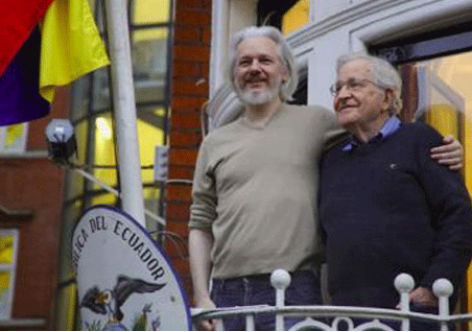
Feature photo | Stefania Maurizi, left, and Julian Assange are pictured. Graphic by Claudio Cabrera for MintPress News
Jimmysllama is an independent researcher and writer who provides balanced, critical analysis with a focus on the Boston bombings, Magnitsky Act, and WikiLeaks. She is currently trying to stay warm in the Midwest. You can read more of her work at jimmysllama.com and find her on Twitter at @jimmysllama.
Baltasar Garzón whipped Piñera in an open letter "He seems not to understand that the people are not enemies but victims" The exjuez was in Chile for the Latin American Forum of Human Rights, held between January 23 and 25. His message contains criticism of the judiciary and security forces, and praise of protesters for their "courage and dignity."
By Baltasar Garzón: Chile in the heart: Open Letter to the People of Chile
Dear Chileans and Chileans:
I write again and this time I am addressing the people of Chile, after the open letter to President Piñera published on October 23 on which, by the way, I have not received an answer.
In that letter I expressed my pain and deep concern about what was happening in Chile, a country with which a perennial bond joins me and for which I feel a special affection. It seemed to me then, and it still seems to me now, that the Government's response to the social outbreak has been absolutely disproportionate, against a town that demonstrates on the street expressing that it no longer supports so much inequality, so much injustice, abuse and corruption.
I also said in that letter, and I have said it in other forums, that the army is not prepared to control public order but to make war, to bend the enemy or destroy it and that when it goes out, things only get worse. . But with stupor I have been able to see how Piñera has tried again and again the intervention of the military. He seems not to understand that the people are not the enemy but the victim, and that the people must be protected and not punished with exceptional measures.
It is paradoxical that this social outbreak took place in a country that - it was said - was an oasis in Latin America and intended to be displayed before the world as a guarantor of the environment to lead a coordinated global response to the climate emergency at COP 25 of the one that Chile had to have hosted. It was not so because Piñera and his government could not allow the leaders of the rest of the planet to see how the executive was unable to manage social demands, giving as the only response repression and more repression against his own countrymen, without any shame.
You will surely know that after that letter I traveled to Santiago de Chile to participate in the Latin American Forum of Human Rights, held between January 23 and 25. I met with associations of victims, human rights organizations and civil society to learn their impressions of what happened since October 18. I confess that it was a very hard day personally and what I have known has increased my degree of outrage. An outrage that has accumulated during these three months, but has already reached a level of stupor in the face of such cruelty, carelessness and incompetence. Senseless repression
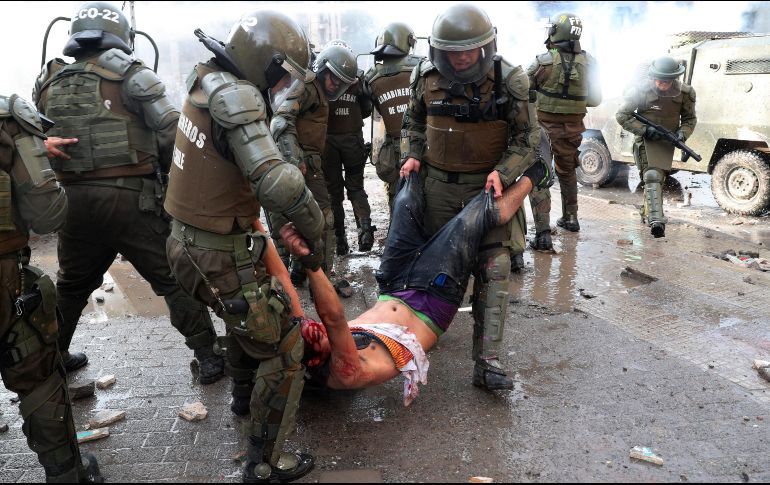
During my brief stay in Santiago, I went to personally check what civil society had transmitted to me through hundreds of messages from Chile, but also from many other countries and from the Chilean community itself in Spain. I went to the Plaza de la Dignidad (ex Plaza Italia), where I witnessed how the public force is not being exercised to control public order and guarantee the right to protest, but to damage, injure and injure those who exercise their right to Freedom of expression The members of the First Line, with whom I had the opportunity to speak in the historic building of the Senate, had exposed me their despair and fear of repression deployed and sustained by the State. In the vindictive act, they lent me a helmet, surrounded me and protected me so that I was not injured myself, during the time in which recklessly, I insisted on verifying the reality of what they had denounced me.
I must admit that I did not know what the guanaco applied to a protest was until I saw a boy flying with his bicycle because of the impact of pressurized water; I didn't even think that the tear gas tube housing would have such an impact on my face until I checked it on one of the young women who accompanied me; or that the fat and acid of its composition, irritate so much; nor that the pellets that empty innocent eyes were shown as sinister trophies so as not to forget the pain ... In the face of it, wooden or plastic shields, the anger contained in impotence and the certainty that one had to be there, between women and men of all ages that showed their determination to face the risks against their safety, with exemplary strength. I evoked there in La Alameda to Pablo Milanés pointing out the crimes of the dictatorship in his song, "I will step on the streets again of what was bloodied Santiago .".
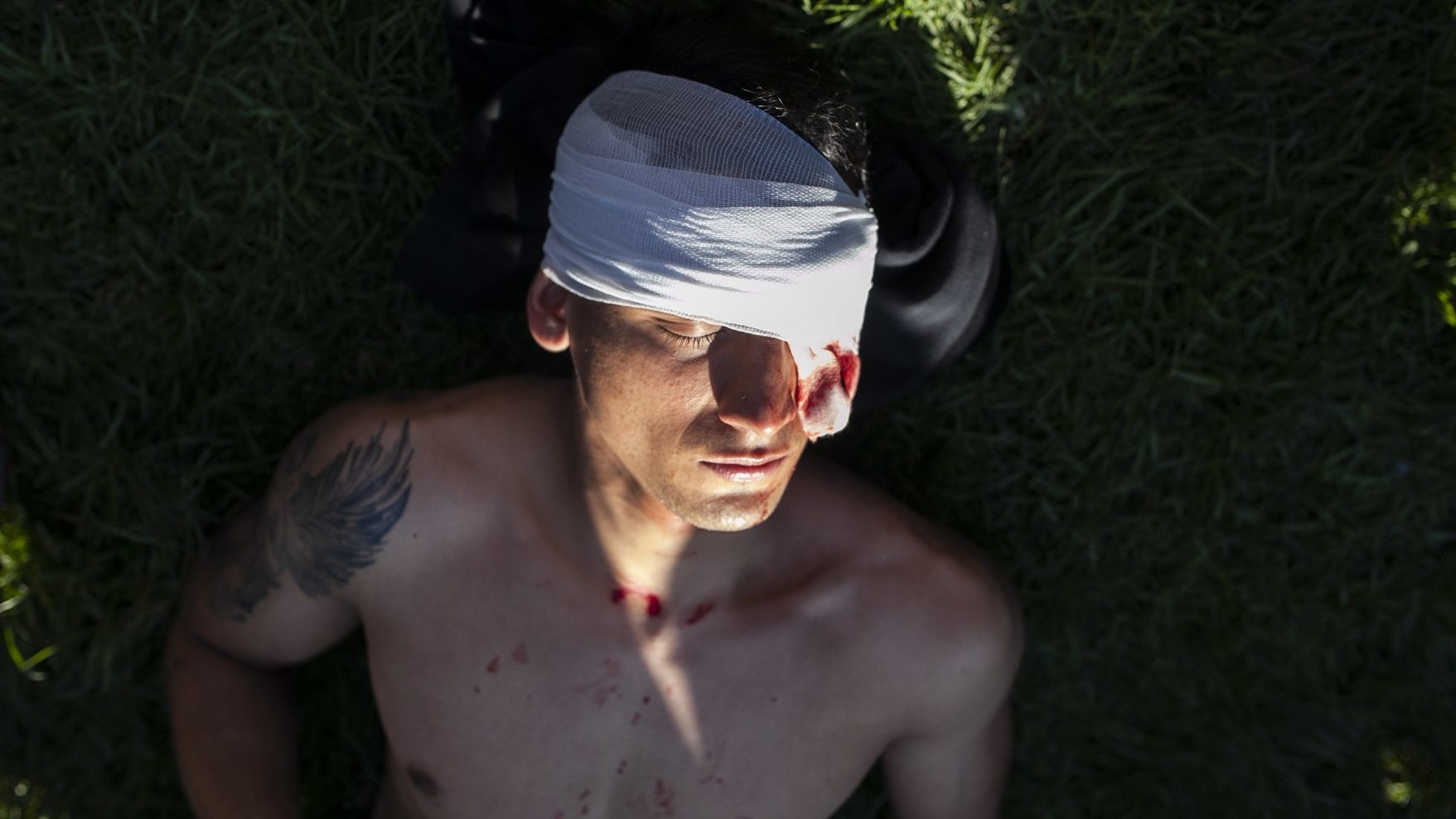
Protesting in Chile may well cost you your life or an eye of the face, as in fact unfortunately it has happened and continues to occur. But I am excited to think that despite this high price, hundreds and thousands of people go out to demand guarantees of a better future. The Chilean people are an example of courage and dignity for the entire world. The emotion in writing these phrases is present to me again, as in the Alameda, when I hug and be embraced by hundreds of you. They have all my respect and admiration.
There will be no impunity
I reiterate my solidarity with all the victims, with the families of the deceased and the disappeared, with the sexually assaulted women, with those who have been tortured, with the wounded, with whom they have lost an eye and, of course, also with Gustavo Gatica and Fabiola Campillay to whom the vision has been completely taken away. They will not be forgotten. There will be no impunity. They have my word. It is my commitment.
I never thought that I would return to Chile to witness such a serious social emergency. Nor did I imagine that in the 21st century a government, supposedly democratic, was going to recreate the worst of the fiercest times. I have lived it in the first person and - I must tell you - it is also what is being seen from outside. Piñera, Rozas, Chadwick, Blumel and Guevara are in the sights of the international community. History will not absolve them.
Not for nothing the popular support of the government is of a scarce 4%, a figure low enough to resign and call elections or to carry out a change of direction in the direction that the citizens are asking for. But no. They prefer to hold on to power, they don't care how many more deaths occur, they don't care how many more eyes they have to blind; how many more bodies to torture; how many more women have to be vexed and how many more people have to be jailed. Unfortunately, these complaints are not answered and the hardness is used again to preserve expired privileges; to sow the constituent process with traps, limiting as much as possible the need for profound change that the Chilean people demand. The new norms, instead of guaranteeing freedoms, restrict them and put the penal code before any other option, which leads to impunity for those who repress them.
They are wrong. The effort must be oriented to generate meeting spaces and dynamics of social dialogue that have not occurred so far, returning to the citizenship the role they should have in every democracy.
Your boss is the town, president
I turn to you President Piñera again to say: You are a president, that is, an errand, your boss is the people of Chile. It cannot govern as if the country were one of its companies. You cannot demand to be applauded and supported. Citizens have every right to disagree with you and express it, because the country belongs to all Chileans, not you or the five or six families that are believed to be their owners, who profit from money every month. of pensions and deprive men, women, girls and boys of water.
I am also addressing the prosecutors and prosecutors of Chile, judges and lawyers in general: I have been able to verify with concern that Chilean institutions, including the Prosecutor's Office and the Judiciary, are not generating the necessary trust in citizens, those who do not perceive that there is an act of good faith, but think that other interests are defended and not the legitimate social demands. This absence of connection nodes between society and state institutions causes a level of rejection and confrontation that is a highly dangerous drift.
In this context, and, in the same direction that jurists who defend human rights are doing when trying to limit their complaints to excesses, I ask them not to be pressured, not to allow justice to be instrumentalized, that remain impartial, thoroughly investigate all human rights violations and fearlessly formalize, accuse, judge and condemn those in law, regardless of their position and position. You are currently, in my opinion, the only thing that guarantees that Chile continues to be considered as a country in which the rule of law can be proclaimed. The limit to succumb to arbitrariness is very close and with it the most absolute helplessness for a people very punished for impunity.
Justice is not and cannot be repressive against that people, but it must defend those who need it most against the breaking of the law and the violation of human rights, by those who have more obligation to respect and protect it. It is a requirement of every democratic State of Law.
Repression in Chile leaves hundreds of protesters with eye injurie
I quote here the words that a citizen told me: “The State of Chile has been built under the logic of impunity. Lack of state conviction. There will be no justice for the victims. ” What despair denotes this phrase! What a lack of faith in those who administer the country! This being the case, the protest is understood, it is understood that, when there is no more response than the harsh repression, the people who know their rights demand, in this era of Internet and almost magical technology, the freedoms that they want to snatch away of projectiles in the face or tear gas. Reflect on it.
To General Rozas and to the body of Generals of Carabineros of Chile I say: Do you think it is logical that there have been more than 20 fatalities and about 770 complaints of torture including more than 150 of sexual connotation? Do you think that 405 eye injuries or traumas have been caused in three months or that more than 2,000 people have ended up in prison or that more than 3,600 people have been injured and more than 2,000 of them have been shot by bullets, pellets, pellets and bombs? tear? These are all official figures of the National Institute of Human Rights, creepy figures.
Make no mistake, the perspective that is being given out is that in Chile human rights are being violated at this time, that whoever would have to defend them is not doing it and once again they are the victims, it is society, it is the people the one who is demanding that protection that the institutions do not offer him. If Carabineros de Chile controlled public order and at the same time allowed anyone who wants it to manifest peacefully, the so-called First Line would not exist.
To the colonels, captains, elders and lieutenants, to the sergeants, capes and the simple carabineros I say: they belong to a hierarchical institution, but in accordance with Chilean law and international law, when a superior gives a manifestly illegal order (such as is to torture, sexually assault or vex, shoot the face, strike to harm and in general use force without justified cause), that order cannot be heeded because if it is complied with, criminal liability is incurred. There is no due obedience regarding manifestly illegal orders.
To those who are part of the government of Chile, I say: it is not typical of a democratic government to allow so many abuses and abuses, but rather to take preventive and corrective measures regarding human rights violations. Despite all the reports, both from national and international organizations, such measures have not been adopted or have been insufficient, while publicly endorsing the police chief, who in turn supports the police who violate rights. humans, thus guaranteeing impunity. And in the meantime, who supports the victims? Who gives real and not merely bureaucratic response from the institutions to the violation of their rights? The authorities are only dedicated to preserving the tranquility of a few, while citizens lose it by demanding that they change course towards a more egalitarian and more just country. Government of Chile admits human rights violations in protests I have been able to verify that those who protest do so because they lack the most essential. What they ask for is human rights, they are economic, social and cultural rights. We are talking about Education, Health and Housing, we are talking about the human right to water, to live with dignity. How will the social reaction not be justified when water is privatized in this country and its agricultural use is put before large plantations to human supply, as the different groups denounced me with evidence, which also identified serious conflicts of interest in members of the government?
Mr. President, what preventive measures is your government taking to avoid the regret of more dead, wounded, tortured, one-eyed or blind people in the coming months? Months that will be key for the future of Chile, with a constituent process underway that is already trying to dynamit the most extreme right that, once again, reveals its true intentions.
The support of the international community
The global human rights landscape today has two aspects, one to develop them progressively, as a product of a growing social conscience in defense of the most vulnerable. The other is reactionary, driven by the extreme right that seeks precisely involution and the return to past positions that we already thought were overcome, of intolerance, discrimination and denial of anyone who is different or thinks differently from them. That inertia of the denial of the extreme right, of coercion, of the absence of justice, of the elimination of rights is a fact that Chile is experiencing. It is fascism that has remained dormant and also seems to have awakened in too many parts of the world.
This is a historic moment in which the international community is very attentive to what is happening in Chile and therefore will continue to support the people in their legitimate social demands and observing and denouncing human rights violations. There is a unique opportunity to build a truly democratic State in common that guarantees equality between men and women, that does not discriminate against their original peoples but that feels proud of them, that stops treating the Mapuche ethnic group as terrorists for demanding their rights That really protects children, that educates without class differences, that takes care of their older adults guaranteeing decent pensions and quality health, in short, it is time to build a State that guarantees the well-being of everyone.
That phrase, Never Again !, that became famous in Argentina and Chile for the struggle of the victims for so many years, will have to be coined again here, because you can not consent to impunity to radiate this part of Latin America again .
Don't forget, Mr. Piñera: your political responsibility is clear. His criminal responsibility is under investigation, after several complaints of crimes against humanity. We hope that the Office of the Prosecutor and the Chilean Courts maintain their independence and impartiality, because there are very good jurists in Chile who know perfectly well that there is criminal responsibility for acquiescence in the face of massive and systematic violations of human rights, and that this responsibility corresponds to the hierarchical superior and to the entire chain of command over those who directly commit the facts, including who ultimately has the supreme command of the country. I did not forget it.
Baltasar Garzón is a lawyer, member of CLAJUD and president of FIBGAR